
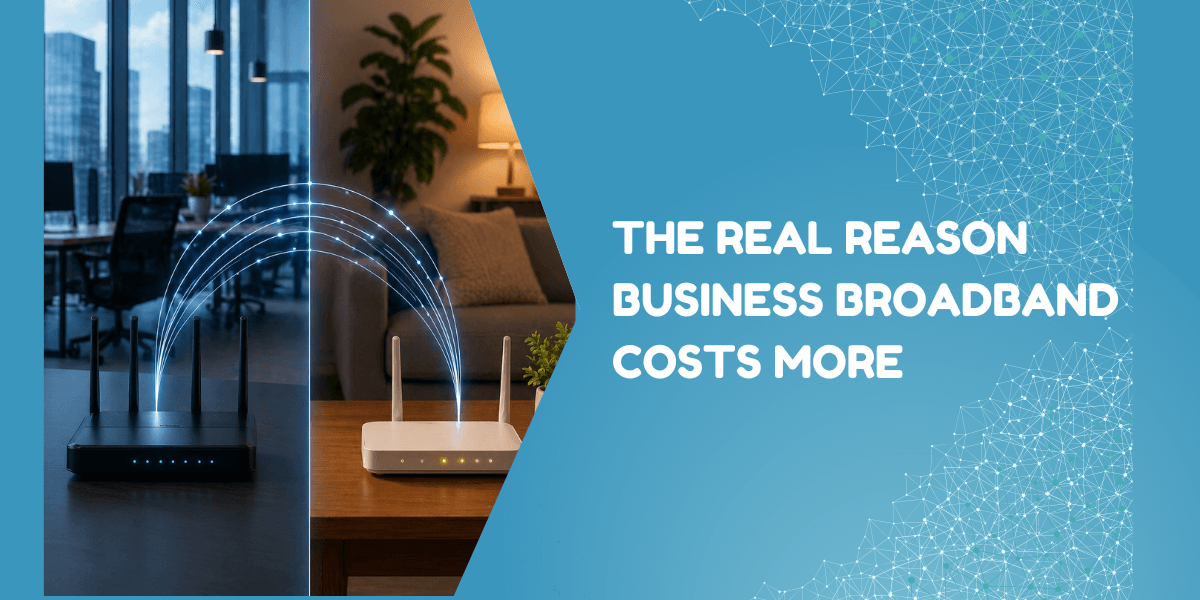
If you have ever compared broadband packages for your business and found yourself paying significantly more than your home internet bill, you are not alone in wondering why. Business broadband consistently costs more than residential connections — typically between £30 and £80 per month compared to £25 and £45 for a standard home package — and understanding what drives that difference helps you make a more informed decision about what your business actually needs.
The short answer is that business broadband is a fundamentally different product. The same fibre cable may run to your premises, but what sits behind it — the service agreements, the support, the contention ratios, the security, and the hardware — is built to a different standard. This guide explains each of those differences and helps you work out whether your business is getting value from its current connection or paying for more than it needs.
What Is Business Broadband?
Business broadband is a dedicated internet connection designed and configured specifically for commercial use. Unlike a residential package — which assumes the connection will be shared among a small number of household members for general browsing, streaming, and occasional video calls — a business connection is designed to handle multiple simultaneous users, heavy data traffic, and the continuous, all-day use that commercial environments demand.
Business packages typically include faster upload speeds, lower contention ratios, stronger security, priority support, and a static IP address as standard. Each of these elements adds cost — but each also delivers a specific operational benefit that most businesses cannot afford to go without.
Why Is Business Broadband More Expensive? The Six Key Reasons
1. Service Level Agreements and Guaranteed Uptime
The most significant cost driver in business broadband is the Service Level Agreement, or SLA. An SLA is a contractual commitment from your provider to fix faults within a defined timeframe — and on a business connection, that commitment is backed by financial penalties if the provider fails to meet it.
A standard residential broadband fault is typically fixed by the end of the next working day, which could mean waiting until Monday if a problem develops on Thursday afternoon. A business SLA may guarantee a four-hour or six-hour response time, 24 hours a day, 365 days a year, including bank holidays. For a business where internet connectivity is essential to operations, the difference between a four-hour fix and a three-day wait can mean thousands of pounds in lost productivity and missed revenue.
In 2026, Openreach will offer care-level pricing on business lines ranging from standard next-working-day response up to care level 4, which provides a six-hour fix commitment around the clock. The additional monthly cost for the highest care level is typically £4 to £8 per month — a fraction of the cost of a single day’s downtime for most businesses.
2. Contention Ratios and Dedicated Bandwidth
Broadband infrastructure is shared. When you connect to the internet, you are sharing available capacity with other customers on the same exchange or cabinet. The number of customers sharing that capacity relative to the total available bandwidth is known as the contention ratio.
A typical residential broadband connection may have a contention ratio of 50:1 — meaning up to 50 households are competing for the same bandwidth at any given time. During peak evening hours, when everyone is streaming simultaneously, speeds can drop noticeably. Business broadband operates at much lower contention ratios, typically 20:1 or lower, meaning less competition for bandwidth and more consistent speeds throughout the working day.
Business traffic is also typically prioritised over residential traffic at the network level. When the local infrastructure is under pressure, commercial connections are served first. This prioritisation is built into the network architecture and is a direct contributor to the higher cost of business services.
3. Static IP Addresses
Most residential broadband connections use a dynamic IP address — a number that changes each time you reconnect to the internet. For general home use, this makes no practical difference. For businesses, a changing IP address creates problems.
A static IP address — one that remains constant — is essential for businesses that host their own websites or email servers, operate remote desktop or VPN connections for staff working from different locations, run CCTV systems that need remote access, or use VoIP phone systems that require a fixed address for call routing. Business broadband packages include a static IP as standard. Residential packages do not, or charge significantly extra to add one.
4. Priority Technical Support
When something goes wrong with a residential broadband connection, the typical support experience involves waiting in a general queue, working through automated troubleshooting, and potentially waiting days for an engineer visit. Business broadband customers access dedicated support lines staffed by technical teams with business-specific expertise and the authority to escalate faults more quickly through the network.
For businesses that rely on internet connectivity to serve customers, process payments, or run cloud-based systems, the quality of support when something goes wrong is not a peripheral concern — it is a core part of what they are paying for. The additional cost of business broadband reflects, in part, the cost of maintaining that level of support infrastructure.
5. Enhanced Security Features
Business broadband packages typically include security features that are either absent from residential connections or available only as paid add-ons. These commonly include business-grade routers with built-in firewall management, content filtering capabilities, secure VPN support, and protection against DDoS attacks. Some providers include anti-virus scanning at the network level, meaning threats are filtered before they reach individual devices.
For businesses handling customer data, financial records, or any commercially sensitive information, these security provisions are not optional extras — they are basic operational requirements. The regulatory environment in the UK, including UK GDPR obligations, expects businesses to implement appropriate technical measures to protect the data they hold. Business broadband security features form part of that protective infrastructure.
6. Business-Grade Routers and Hardware
The router supplied with a business broadband connection is fundamentally different from the consumer-grade device that comes with a home package. A business router is engineered to handle significantly higher numbers of simultaneous connections — a home router may manage 10 to 15 devices reliably, while a business router can handle hundreds — and to maintain stable performance under sustained heavy load.
Business routers also support more sophisticated network configurations, including VLAN segmentation (separating guest WiFi from internal systems), quality-of-service prioritisation (ensuring VoIP calls are not disrupted by large file downloads), and more granular security controls. For businesses with complex networking requirements or multiple departments, this capability is essential.
How Much Does Business Broadband Cost in the UK in 2026?
Business broadband pricing in the UK varies significantly depending on the technology type, speed tier, and included features. As a general guide for 2026:
- FTTC business broadband (fibre to the cabinet): £25 to £45 per month
- FTTP business broadband (full fibre to the premises): £35 to £65 per month
- SoGEA (fibre without a phone line): £30 to £50 per month
- Leased line (dedicated, uncontended): £200 to £500+ per month depending on speed and location
These figures are for the broadband connection itself and do not include VoIP phone line costs, which are typically billed separately. Businesses that bundle broadband and voice services with a single provider often achieve better overall pricing than sourcing each component separately.
Is Business Broadband Worth It for Small Businesses?

The honest answer depends on how central internet connectivity is to your operations. For the majority of UK businesses in 2026, the answer is yes — and the gap in real-world cost between residential and business packages is narrower than many business owners assume when the full picture is considered.
A business that processes customer payments online, uses cloud-based accounting software, makes video calls to clients, or allows staff to work remotely from any location is functionally dependent on reliable, fast, and secure internet. A single day of downtime caused by a slow fault response on a residential package could easily cost more than a year’s worth of the premium for business broadband.
The calculation is different for a sole trader who uses the internet primarily for email and occasional document sharing from a home office. In that scenario, a residential package may genuinely be sufficient — though the absence of a static IP, business-grade support, and SLA protection still represents a meaningful exposure.
The 2027 Switch-Off and What It Means for Your Broadband
The UK’s Public Switched Telephone Network — the copper infrastructure that traditional landlines and ISDN business lines run on — is being switched off by Openreach in January 2027. For businesses that currently have PSTN or ISDN lines bundled with their broadband connection, this deadline is the most significant communications infrastructure change in a generation.
From January 2027, all voice calls will need to be carried over internet-based connections. Businesses that have not already migrated to internet-based voice services will lose their phone lines at switchover. The migration to a hosted VoIP phone system alongside a business broadband connection has become the standard approach for UK businesses of all sizes, and many are finding that the combined monthly cost of business broadband plus hosted VoIP is comparable to — or lower than — their existing PSTN line and broadband costs combined.
With less than a year until the deadline, businesses that have not yet reviewed their broadband and voice infrastructure should do so as a matter of urgency. The last few months before the switchover will see high demand on providers’ installation capacity, and businesses that act now can migrate on their own terms rather than being forced into a rushed transition.
Which Types of Business Need Business Broadband?
While every commercial operation benefits from the reliability and support of a business connection, there are specific scenarios where the case is particularly clear-cut:
- Businesses with multiple staff sharing one connection — a residential package will struggle under simultaneous heavy use from several users
- Businesses using cloud-based software — accounting platforms, CRM systems, and project management tools require consistently fast upload speeds that residential connections do not reliably deliver
- Businesses making and receiving VoIP calls — voice quality is highly sensitive to connection stability and upload speed; a business broadband connection with quality-of-service prioritisation is essential for reliable call quality
- Businesses handling sensitive customer data — GDPR obligations require appropriate technical safeguards; business broadband security features form part of this
- Businesses with remote workers connecting via VPN — a static IP is required for reliable VPN configuration
- Businesses where downtime directly affects revenue — any operation where internet failure means customers cannot be served or transactions cannot be processed
Frequently Asked Questions
Why is business broadband more expensive than home broadband?
Business broadband costs more because it includes Service Level Agreements guaranteeing fast fault repair, lower contention ratios for more consistent speeds, static IP addresses, priority technical support, enhanced security features, and business-grade router hardware. Each of these elements adds cost but delivers operational benefits that most businesses cannot do without.
How much does business broadband cost in the UK in 2026?
FTTC business broadband typically costs £25 to £45 per month. Full fibre (FTTP) business packages range from £35 to £65 per month. SoGEA connections (fibre without a phone line) cost £30 to £50 per month. Leased lines for businesses requiring dedicated, uncontended connectivity start from around £200 per month.
Can I use home broadband for my business?
You can use residential broadband for business purposes, but it comes with significant limitations. There is no SLA guaranteeing fault repair times, no static IP address, lower contention ratios, no priority support, and weaker security features. For businesses where internet connectivity is essential to operations, these limitations represent a meaningful risk.
Do I need a static IP address for my business?
You need a static IP address if your business hosts its own website or email server, uses remote desktop connections or VPN for staff working remotely, operates CCTV systems requiring remote access, or uses VoIP phone systems. Business broadband packages include a static IP as standard.
What is a contention ratio, and why does it matter?
A contention ratio describes how many customers share the available bandwidth on a given section of the network. A residential connection may have a 50:1 contention ratio — meaning up to 50 households compete for the same bandwidth at peak times. Business broadband operates at lower ratios, typically 20:1 or better, providing more consistent speeds throughout the working day.
What happens to my business broadband when the PSTN switches off in 2027?
The PSTN switch-off in January 2027 affects phone lines and ISDN connections, not broadband itself. However, if your current broadband is part of a bundle that includes a PSTN phone line, that line will need to be migrated to a VoIP alternative. Most businesses are moving to hosted VoIP phone systems alongside their business broadband connection ahead of the deadline.